


Moving a Call Center to the Cloud in Just Two Weeks:
Low-Cost Deployment and Generative AI-Based Quality Evaluation for Every Call

Date Published:2 MARCH 2026

- Required staff to be in the office to answer calls from an on-premises PBX
- Stored call recordings on SD cards, making them difficult to use for analysis
- Evaluated operators only once a year through spot checks of selected recordings

- Enabled operators to answer calls from anywhere with Amazon Connect, making remote work possible
- Built a data utilization foundation using transcription and sentiment analysis
- Established an objective feedback system through real-time generative AI evaluation of all calls
Panasonic Projector & Display Corporation develops commercial projectors and displays. Its products span the B2B market, from large equipment used for projection mapping to displays for corporate customers.
The company’s Customer Support Center handles approximately 8,000 inquiries a year with a team of four. Because the work demands specialized knowledge, ranging from technical consultations with distributors to urgent questions from installation sites, the company has kept the support center entirely in-house rather than outsourcing the work.
After years of relying on an aging on-premises PBX, the team ran up against the limitations of their legacy system and their data analysis capabilities. In 2025, with support from Classmethod, the company deployed Amazon Connect, and it has since begun implementing a generative AI feature for evaluating operators. Mr. Sato, DX lead, and Ms. Shigyo, assistant manager of the customer support center, describe the background of the project and where it is headed.
18 Years of Recordings Reveal the Limits of an On-Premises PBX
Most of the inquiries reaching Panasonic Projector & Display’s Customer Support Center are technical in nature. About half come from the distributors that handle the company’s products, covering product specifications, troubleshooting, and other matters that require specialized knowledge.
“Calls from distributors often come in while they are on site, in the middle of an installation,” Ms. Shigyo said. “The customer is standing right there, so if we cannot give them an answer immediately, the distributor’s credibility is also at stake.”

Because answering these calls requires deep product knowledge, outsourcing the work was difficult. Four employees handle everything from operator duties to writing FAQs and building support tools. Employees who receive feedback from the field firsthand can write more accurate FAQs and design better support tools, and that system has been a strength of the current model.
But the on-premises PBX, in use for more than a decade, had reached its limit.
“Because the phones were fixed lines, you had to be in the office to take a call,” Ms. Shigyo said. “Someone had to be on site from 9 a.m. to 5:30 p.m. every weekday, and remote work simply was not possible.”
In April 2024, Mr. Sato was appointed as head of the DX Office. Hoping to put past call data to use, he checked the recordings and found 18 years of data stored in SD cards. Pulling anything useful from that mass of audio files was difficult, and the data was far from ready for analysis. With veteran employees approaching retirement, he felt a real urgency, knowing that if they left things as they were, the company’s accumulated know-how would disappear with them.

“We have reached a point where generative AI can finally make use of this kind of data, and yet our recordings were still sitting unused as audio files,” Mr. Sato said. “I wanted to convert them to text and build a foundation we could use to improve our FAQs and visualize the underlying issues.”
To address the three challenges of enabling remote work, building a foundation for data utilization, and passing on institutional knowledge, the company decided to move its call center to the cloud.
Deploying the Amazon Connect Starter Package for ¥200,000
As he weighed moving the call center to the cloud, Mr. Sato spoke with other departments in the Panasonic Group that had already deployed Amazon Connect and attended a range of seminars.
“I had been familiar with AWS for some time, so I knew Amazon Connect existed,” Mr. Sato said. “We compared a number of other options, but in the end this one felt like the standard.”
He consulted several vendors, but the answers kept coming back the same, indicating that deployment would take months and incur high costs. Their limited adaptability was another concern, given the company’s plans to connect other systems later on. An internet search then led him to Classmethod, and he reached out.
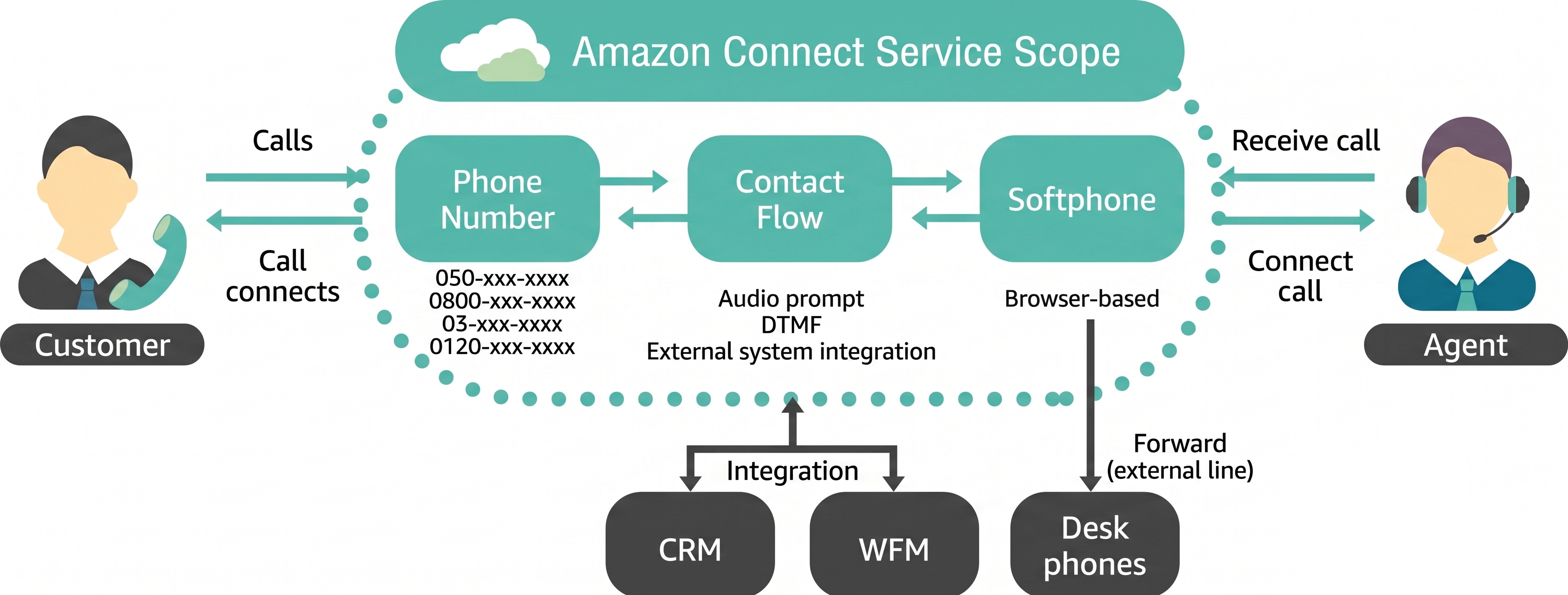
Classmethod proposed its Amazon Connect Starter Package, a service that delivers a complete, pre-packaged cloud contact center environment in two weeks for ¥200,000 (excluding tax). It comes with the standard features the team needed, including call handling, contact flows, call recording, and transcription and sentiment analysis through Contact Lens, along with operational training on how to run the system.
“Compared with the other vendors, it was a very cost-effective proposal,” Mr. Sato said. “To be honest, at first I wondered whether it could really be enough, but once I heard the details, I was convinced it would work for us.”
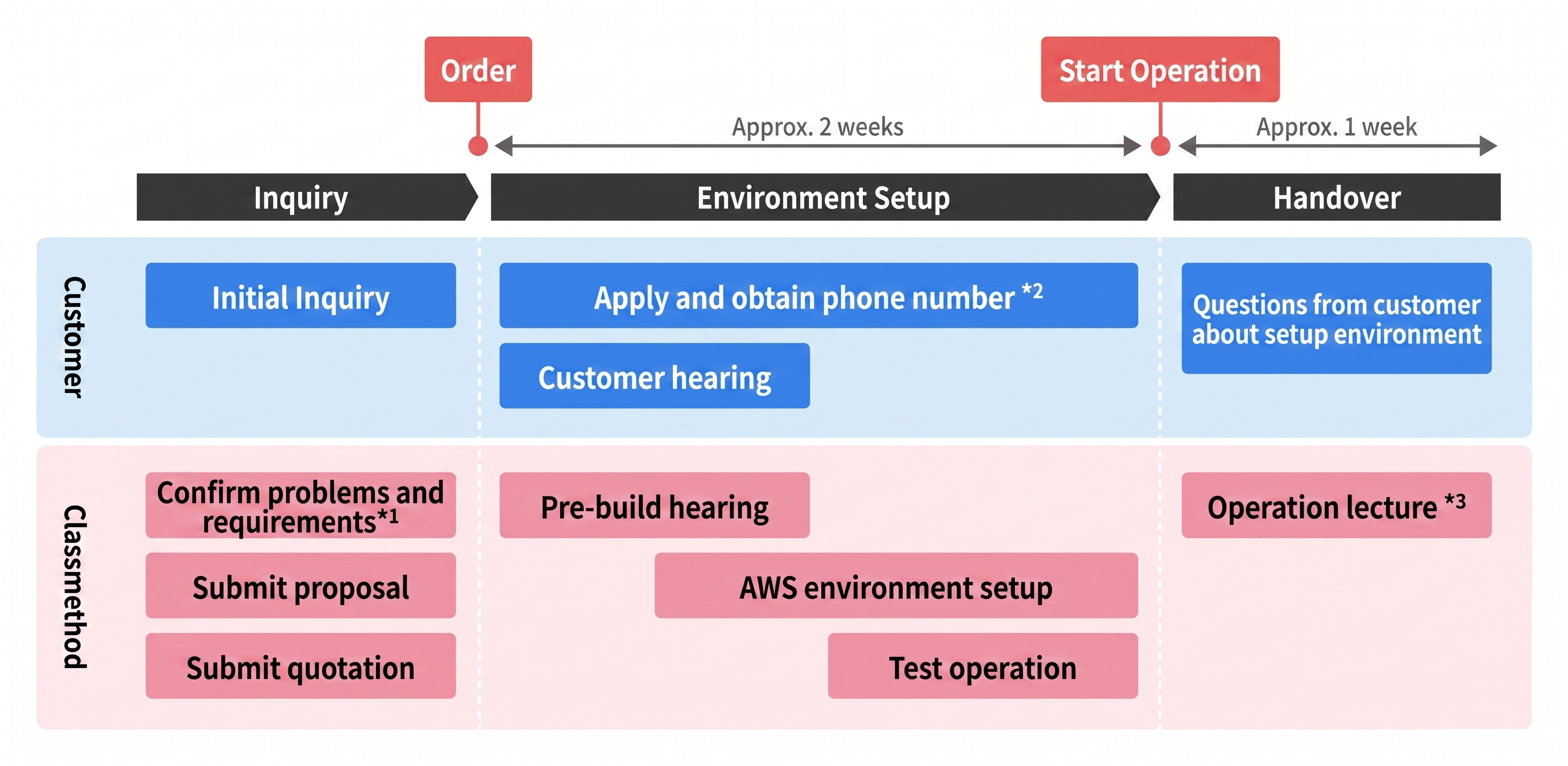
The core features arrived ready to use, with the expectation that the company would customize them to fit its own operations afterward. That matched what the company wanted, which was to start small and try things out. It contacted Classmethod in January 2025 and completed the deployment that March, completing the migration to the cloud in approximately two months.
An Assistant Manager With No Coding Experience Builds Contact Flows in One Month
After deployment, the job of configuring the system for daily use fell to Ms. Shigyo, the call center’s section chief. She had never written a line of code, yet she took on building the contact flows herself.
A contact flow defines how incoming calls are routed and how voice guidance is played. Because the company uses a separate toll-free number for each product line, Ms. Shigyo had to build a flow tailored to each one.
“I was nervous at first, I’ll admit,” Ms. Shigyo said. “But the Classmethod team taught me the basics during the training sessions, and whenever I had questions, they answered them carefully. As I worked through it with their blog posts for reference, I realized I could do far more on my own than I had expected.”
DevelopersIO, the technical blog Classmethod runs, carries a wealth of related articles, including step-by-step Amazon Connect setup guides and explanations of new features. Ms. Shigyo used these posts as a step-by-step guide, working through the setup one step at a time. She finished in approximately one month, and after training the operators, launched full operations by the third month. Nine months after its deployment, the system continues to run reliably.
“Being able to change the settings myself is a huge advantage,” Ms. Shigyo said. “When we were using the on-premises system, even a small change meant calling the vendor, waiting for a quote, and getting the work done two weeks later. Now I can fix it the moment I notice it.”
The staff most familiar with the onsite problems can now improve the system themselves. That flexibility, unique to the cloud, is what keeps a small call center team running.
A Call Center That Keeps Running, Even During a Typhoon
With the new platform running reliably, operators now take calls with a computer and a headset rather than a fixed office phone. As long as they have an internet connection, they can work from anywhere.
“At one point during these nine months, a typhoon came through and stopped the trains,” Ms. Shigyo recalled. “Before, we would have had no choice but to close the call center and switch to a recorded message. This time, everyone took calls from home.”
Keeping calls answered regardless of the weather directly helps maintain customer satisfaction. Operators welcomed the change too.
“Everyone is delighted,” Ms. Shigyo said. “People tell me, ‘I never imagined we’d be able to take calls from home.’ Having more choices in how we work has been a big change for the team.”
Another feature the team has come to rely on is call monitoring. With supervisor permissions, a manager can listen to an operator’s call in real time.
“When a new hire was on a call, I used to have to either lean in and listen from beside them or have them put the customer on hold to ask me something,” Ms. Shigyo said. “Now I can listen to the conversation alongside them, look up what they need, and support them on the spot.”
Because she can also gauge the tone and emotional nuance of the customer’s voice in real time, she can follow up precisely as each situation demands. For a small team expected to deliver highly specialized support, the feature has become essential to both training new hires and maintaining service quality.
Generative AI Evaluation: An Idea Sparked by Classmethod Seminars
After deploying Amazon Connect, Ms. Shigyo began attending Classmethod’s seminars regularly. Classmethod holds free hands-on workshops and new-feature sessions for companies running Amazon Connect. The hands-on workshops, where she could learn by actually doing the work, left the deepest impression on her.
“I could check each setup step and configure it as I went,” Ms. Shigyo said, “so I could take the materials back, adapt them to our own environment, and deepen my understanding.”
Some of the seminars were in Tokyo, and she traveled from Osaka to attend. At one of them, a feature caught her eye: an operator evaluation capability in Amazon Connect Contact Lens, powered by generative AI.
“We need this,” Ms. Shigyo said. “It solved exactly the problem I had been feeling all along.”
Until then, the company had assessed operators’ service quality once a year, asking a specialized department within the Panasonic Group to conduct the review. But operators chose the audio samples themselves, which made the real issues hard to see. The annual review also scored and compared operators, putting pressure on the people doing the evaluating and the people being evaluated alike.
The generative AI feature can evaluate all 8,000 calls a year automatically. Operators can review their own calls whenever they like, and because the AI applies a consistent standard, evaluation results no longer vary by reviewer. What interests Ms. Shigyo most is its ability to detect dialect and filler words such as “um” and “uh”.
“We serve customers across the country, so using clear, easy-to-follow language matters,” Ms. Shigyo said. “But some habits are hard to catch yourself. If evaluating every call makes them visible, I think it will give each operator something new to notice about their own work.”
What lowered the barrier to adoption was the next-generation Amazon Connect pricing model. Voice call usage charges are slightly higher than with the previous generation, but the price now bundles in Amazon Q in Connect and the conversation analytics tool Contact Lens, which makes the generative AI features cost-efficient to use. For the company, the feature could be used for an additional cost of approximately $20 per month.
In October 2025, the company formally decided to adopt the generative AI performance evaluation feature. It is now implementing it with Classmethod’s support.
Establishing a System for Quickly Implementing the Latest Features Through Close Collaboration with Classmethod

Once the evaluation feature is in place, the next step comes into view. Ms. Shigyo has her eye on the operator assistance capability in Amazon Q in Connect, which analyzes a conversation in real time and suggests the best answer drawn from manuals and specification sheets.
“Veteran staff and new hires have different levels of information and knowledge so differences in the quality of answers are a problem every call center shares,” Ms. Shigyo said. “If the AI can suggest answers to fill those gaps, I expect it will help us reduce our reliance on individual expertise.”
For Mr. Sato, the partnership comes down to keeping pace with AWS.
“AWS adds new capabilities almost daily,” Mr. Sato said. “We want to be in a position to put new features to use as soon as they appear. We are counting on Classmethod to bring us the latest developments that we could not keep up with on our own.”
At AWS re:Invent 2025, AWS’s annual conference held in December 2025, AWS announced numerous updates to Amazon Connect. They included a test feature for simulating contact flow behavior and improvements to generative AI accuracy, both of which the team can put to use going forward. Classmethod engineers who attended in person picked up these developments early and are already integrating them into proposals for clients.
What began with the Amazon Connect Starter Package has grown, through seminars and regular exchanges, into an ongoing partnership. Classmethod will continue to support Panasonic Projector & Display in advancing its contact center’s DX activities.