


Data-Driven Manufacturing to Safeguard Pharmaceutical Supply:
Visualizing the Factory Floor with PLC Data To Cloud
Date Published:16 MARCH 2026

- Manual data extraction via SD cards and analysis in Excel
- Physical presence on the factory floor required to access equipment data
- Difficulty advancing discussions with other vendors due to lack of in-house cloud expertise
- Manual work was still required to collect certain data points

- Real-time streaming of manufacturing data to the cloud
- Remote monitoring and analysis via intuitive dashboards
- Empowered internal teams to develop custom data visualizations
- Automated data collection and PLC write-back capabilities, overcoming previous technical barriers
Shionogi Pharma Co., Ltd. manufactures pharmaceuticals and clinical trial drugs for the Shionogi & Co., Ltd. group. As a core production facility for solid dosage forms, injectable formulations, and investigational drugs, the Settsu plant had long envisioned leveraging manufacturing data, yet connecting factory equipment to the cloud remained a challenge. In June 2023, a referral from Shionogi’s Digital Transformation (DX) division led the team to Classmethod’s PLC Data To Cloud solution. Today, the plant successfully streams equipment data to the cloud in real time.
Over the course of the project, Mr. Hayashi and Mr. Yamada taught themselves AWS and built their own dashboards. This interview features Mr. Hayashi and Mr. Yamada from the Industrialization Technology Department, alongside Mr. Harada and Mr. Takanashi from the Factory Technology Department.
Manufacturing Data: The Backbone of a Stable Drug Supply
In pharmaceutical manufacturing, nothing matters more than a stable supply.
“Patients are waiting for their medication,” Mr. Hayashi said. “We cannot fail them. To maintain consistent quality and keep production running, I believe utilizing manufacturing data is essential.”
Pharmaceuticals undergo rigorous quality control testing before shipment. If a batch fails, the supply plan is affected, and tracing the root cause demands detailed production records. Shionogi Pharma recognized this need early.

“We’d had the idea of collecting and visualizing shop-floor data for more than ten years,” Mr. Takanashi said. “But the infrastructure to make it happen simply wasn’t there.”
While the factory recorded all data required by GMP (Good Manufacturing Practice) standards, parameters not directly tied to product quality, such as current values, torque readings, and equipment ON/OFF timing, went uncaptured. Even when data was available, retrieval required physically pulling SD cards and manually opening files in Excel. Because access necessitated a trip to the production floor, real-time monitoring remained out of reach.
“What I wanted,” Mr. Hayashi said, “was a system where data flows to the cloud automatically, without anyone having to think about it.”
How to build an automated pipeline from factory equipment to the cloud: that was the challenge Shionogi Pharma needed to solve.
Project Launch, Backed by Classmethod’s Track Record with Shionogi
Shionogi Pharma had explored various options with cloud vendors to move manufacturing data to the cloud, but the process did not go as smoothly as hoped.
The turning point arrived when the team consulted Shionogi’s DX division; at the time, Classmethod was already supporting the group’s company-wide AWS environment.
“When I explained the situation,” Mr. Hayashi recalled, “they shared what Classmethod had done for Shionogi and suggested we work together.”
Manufacturing sites involve two distinct technology domains. Operational Technology (OT) governs factory equipment and PLCs through closed networks with specialized protocols, while Information Technology (IT) handles cloud services and enterprise systems. Bridging the two requires a partner with expertise in both. Classmethod met that requirement.
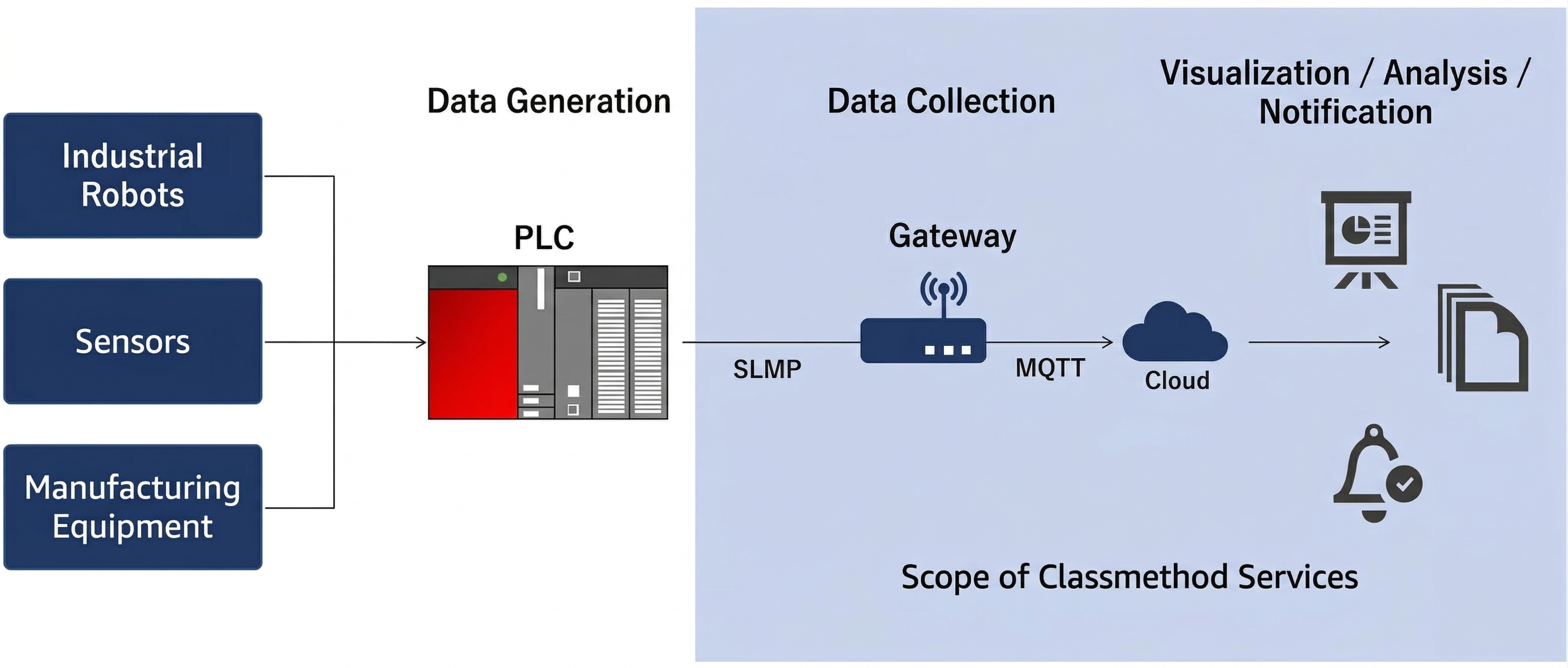
Classmethod proposed PLC Data To Cloud, a solution that stores PLC data in the cloud for visualization, analysis, and alerting. The project launched with a three-phase plan to expand data utilization incrementally.
Phase 1 ran from June 2023 over approximately six months. The team installed a gateway connecting factory equipment to the cloud and built a data collection structure targeting tablet press machines in Building 208. In 2024, Phase 2 upgraded the gateway software to enable integrated data management across multiple buildings. Phase 3, launched in 2025, focused on developing PLC write-back capability and expanding the approach to Building 207.
The initial effort focused on installing a gateway for the tablet presses in Building 208 and beginning PLC data collection. Once data started flowing to the cloud, the team’s confidence in the approach solidified.

“You can have the best cloud environment in the world,” Mr. Takanashi said, “but it’s useless if you can’t connect it to the factory floor. Getting that entry point in place was a big breakthrough.”
Building Dashboards In-House to Expand Data Use
In 2024, the project moved into Phase 2. The team updated the gateway software to collect data from multiple PLCs simultaneously.
Classmethod also prepared documentation to support future in-house development. The most notable outcome of this phase: Mr. Hayashi and Mr. Yamada built the data dashboards themselves. At the start of the project, neither had any real AWS experience.
“I was starting entirely from scratch,” Mr. Hayashi recalled. “But once I saw the data flowing, I began studying to acquire SQL and data visualization techniques. I had always had a clear vision of the visualizations I wanted to create, and it finally felt like I had the tools to realize that vision.”
Mr. Yamada implemented analytical processing using Lambda, steadily broadening what the team could do with the collected data. The dashboards, initially viewed only by Mr. Hayashi and Mr. Yamada, now have a growing number of users within the department.
“Data that used to be hard to get is now available right away,” Mr. Yamada said. “It comes out in a consistent format, which makes it easy to use. Feedback from within the company has been positive.”

“Classmethod created thorough documentation for us, multiple times,” Mr. Harada added, “and kept supporting us so we could expand what we’re able to do on our own.”
Writing Data Back to PLCs: A New Technical Frontier
In January 2025, Phase 3 began with a new challenge: writing data back to PLCs.
The trigger was a gap in the continuous manufacturing line*. Weight values still required visual confirmation by an operator and paper-based recording.
*Continuous manufacturing produces finished products in an uninterrupted flow from raw material input, unlike the batch production that has traditionally dominated pharmaceutical manufacturing. Development of continuous processes has accelerated in recent years.
“We’ve been working to reduce manhours on the continuous manufacturing line,” Mr. Harada said, “but some steps, like recording weight values, still needed a person on site. We asked ourselves whether we could automate that.”
While modifying the Manufacturing Execution System (MES) was an option, it would have required costly changes to both the MES and the PLCs. Instead, the team chose to write calculated values from the gateway back to the PLC.
While accumulating data in the cloud allows for dashboard visualization and analysis, the MES is designed to read data from the PLC and cannot reference cloud data directly. By writing the calculation results from the gateway back to the PLC, the MES can simply continue to reference the PLC as it always has, eliminating the need for any system modifications.

PLC write operations demand caution. A careless write could cause equipment to malfunction. The team limited writes to areas with no impact on production and validated the approach through repeated testing.
“There were times we had to ask for quick turnarounds on a fixed schedule,” Mr. Harada said. “Classmethod built the system smoothly and provided a foundation for validation testing. We’re extremely grateful for that.”
Preparation for GMP compliance is also underway. Gateway validation is complete, and the team is now developing procedures for formal production deployment.
Towards a Smart Factory
With the project’s three phases, Shionogi Pharma has built a solid foundation for manufacturing data visualization. The team’s ambitions extend further.
“We’re not limiting ourselves to manufacturing data,” Mr. Harada said. “We want to bring people, goods, and financial data together in the cloud. When something goes wrong, we want to analyze the cause from multiple angles.”
“Aggregating data means executives can use it for decision-making,” Mr. Takanashi said. “Operators on the floor can check their own process status on a dashboard or digital signage. I’d like to see an environment where everyone, at every level, can run their own PDCA cycle.”
“There are areas we simply can’t reach on our own,” Mr. Hayashi said. “Working with partners who have specialized expertise gets us closer. That’s the kind of collaboration I want to keep pursuing.”
“I want to grow the user base internally,” Mr. Yamada said, “so that anyone who needs data can access it. For people who find it intimidating, I’d like to be the person who bridges that gap.”
Shionogi Pharma is scheduled to reintegrate into Shionogi & Co., Ltd. in April 2027. Mr. Hayashi sees this as an opportunity. “The environment will change,” he said, “but I want to use that as a catalyst to accelerate data utilization even further.”
Classmethod provides support spanning cloud services and factory-floor connectivity, from upstream architecture to downstream operations. The Classmethod team will continue working alongside Shionogi Pharma as the company pursues its smart factory vision.