

Classmethod Patents “ghoost” AI Agent Technology for Inheriting Organizational Knowledge
Multi-Agent Integration Generates Role Models; Early Deployment at Hokkaido Cultural Broadcasting Records 92.3% Peer Approval Rate
Classmethod, Inc. (Headquarters: Minato-ku, Tokyo; CEO: Satoshi Yokota; “Classmethod”) obtained a patent on April 30, 2026, for technology that reconstructs the knowledge and judgment patterns of individuals within an organization as AI agents that can be passed down. The generative AI service ghoost, built on this patented technology, is already in practical use through an early deployment at Hokkaido Cultural Broadcasting Co., Ltd., where it recorded a Peer Approval Rate* of 92.3%.
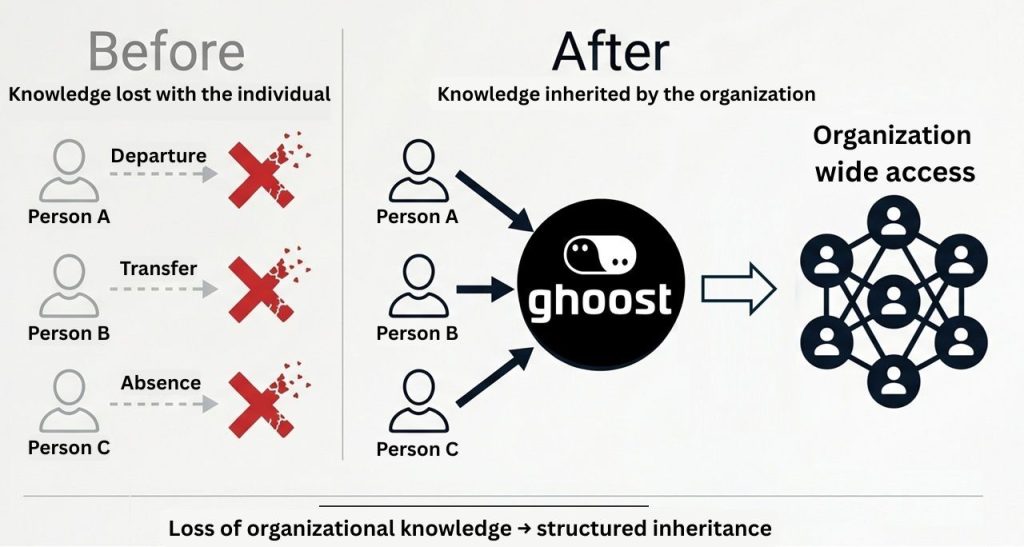
The judgment-based knowledge that individuals accumulate inside organizations has long been lost through employee departures and transfers. Companies have discussed ways to reduce dependence on individual expertise and improve knowledge management for years, but methods for inheriting judgment itself had not been systematized. This patented technology structures the inheritance of organizational knowledge and directly addresses a core challenge in human capital management.
* Peer Approval Rate refers to the percentage of ghoost-generated responses that third parties, such as colleagues and related stakeholders, approve of as sounding like the person. Because the evaluation is based on feedback from those around the subject instead of the subject’s own assessment, the metric indicates the technology’s ability to inherit organizational knowledge.
■ About ghoost
ghoost is an AI agent service that reproduces an individual’s judgment patterns from how they think, what they know, and what they remember. Through automated interviews and integrated analysis, an initial AI agent can be generated for a single person in approximately one to two hours, enabling rapid organization-wide deployment.
The break-even threshold for adoption is designed to be low. In a 300-employee organization, the monthly usage fee is estimated to be recoverable by reducing meeting time by just under 10 minutes per person per week. These modest individual savings can translate into productivity gains across the organization.
■ Validation Results at Hokkaido Cultural Broadcasting (UHB)
UHB launched its early deployment in March 2026.
Broadcasting, by the nature of program production, depends heavily on individual judgment, experience, and sensibility. At UHB, the team had long recognized the lack of a way to pass senior employees’ judgment frameworks on to younger staff. This deployment marked the company’s first structured, organization-level effort to verify whether such individual-dependent know-how could be inherited.
| Metric | Result |
| Subjects | 16 |
| Sessions conducted | 162 |
| Peer Approval Rate | 92.3% |
“When we first considered piloting this technology, we thought that systematizing ‘how high-performing employees think’ was what it meant to turn knowledge into intellectual property,” said Mr. Ayuki Sugimoto of the DX Promotion Center, Media Division, Hokkaido Cultural Broadcasting Co., Ltd. “As the validation progressed, we came to recognize that the real organizational know-how, the kind that becomes a genuine asset, lies not only in a handful of exceptional people but in the small judgments employees make every day. We are now beginning to see how judgments that had been scattered across the workplace and locked inside individuals can be converted into assets the entire organization can inherit.”
■ Patent Overview
| Title | AI Agent Provision System, AI Agent Provision Method, and AI Agent Provision Program |
| Patent Registration Number | Japanese Patent No. 7857639 |
| Registration Date | April 30, 2026 |
| Issue Date | May 13, 2026 |
| Application Number | Japanese Patent Application No. 2025-135907 (parent application: Japanese Patent Application No. 2025-134990; related divisional application: Japanese Patent Application No. 2026-001423) |
| Claims | 18 |
| Inventors | Satoshi Yokota, Hirokazu Tsukuma, Tsutomu Tateno, Ryota Moriwaki |
At the core of the patent is technology that integrates the feature representations of multiple AI agents to generate a single AI agent functioning as a “role model” optimized for a specific position or responsibility. This makes it possible to build judgment models that do not depend on any one individual and that the organization itself can inherit.
Principal technologies covered by the patent:
- Role model generation through the integration of multiple AI agents (Claim 14)
- Processing flow for automated interviews and persona model extraction
- Mechanisms for cross-organizational reference and operation of role models
- Continuous learning and updating to improve accuracy over time
About Classmethod, Inc.
Classmethod, Inc. is a technical partner that supports corporate digital transformation (DX) with a focus on cloud-native technology areas, including Amazon Web Services (AWS), data analysis, mobile, IoT, and AI/machine learning. In terms of AWS support, Classmethod has been recognized as a top-tier partner continuously since 2015 and has won the “AWS Consulting Partner of the Year” (awarded to the top partner in Japan) five times. In 2022, it received the global accolade of “SI Partner of the Year,” and was named a finalist again the following year in 2023, establishing its position as a world-class AWS partner in both name and substance.
To date, Classmethod has supported approximately 5,600 companies and managed/built a cumulative total of over 40,000 AWS accounts. The company also heavily emphasizes a culture of technical knowledge sharing among its engineers, having published over 60,000 technical articles on its owned media “DevelopersIO.” Additionally, it operates “Zenn,” a knowledge-sharing platform for engineers, contributing further to the development of the tech community. Guided by the philosophy of “continuously contributing to the creative activities of all people,” Classmethod proposes optimal technologies that enhance its customers’ business value.
- Headquarters: 26F Hibiya Fort Tower, 1-1-1 Nishishimbashi, Minato-ku, Tokyo
- Representative: Satoshi Yokota, Representative Director and President
- Core Business: Cloud implementation support, big data infrastructure construction, mobile app development, LINE technical support, AI/machine learning technical support
- Official Website: https://classmethod.jp/
- Technical Blog “DevelopersIO”: https://dev.classmethod.jp/
- Tech Information Community “Zenn”: https://zenn.dev/
- Facebook Page: https://www.facebook.com/classmethod/
- Official YouTube Channel: https://www.youtube.com/c/classmethod-yt/